
Free investor guide · Cost segregation for STRs
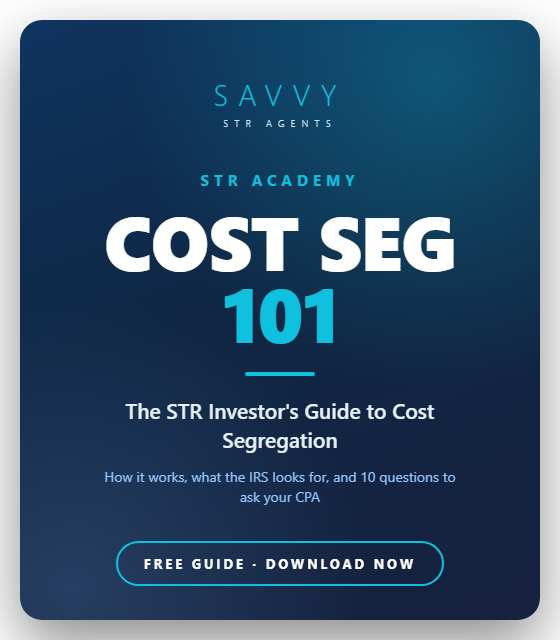
Understand cost segregation before you buy your next short-term rental.
A guide to how cost segregation works and the questions to bring to your CPA. Written for investors buying STRs.
Licensed real estate brokerage
STR-experienced agents
Learn from our experience
Sourced from IRS guidance
Referrals to licensed cost segregation providers
WHAT'S INSIDE
A 20-minute read that makes your CPA conversation sharper.
What a cost segregation study is, and how it reclassifies a property into components
The core investor benefit: how writing off more in your first years can lower your tax bill and free up cash to reinvest
The recovery periods, with examples
How the 2025 bonus depreciation change fits in, and the dates that matter
Why average guest stay and material participation come up in STR tax conversations
What a quality study looks like, according to the IRS Audit Techniques Guide
10 questions to ask your CPA before you buy
What is cost segregation?
When you buy a rental property, the IRS lets you write off its cost a little each year. This is called depreciation. Normally, the whole building is spread over 27.5 or 39 years. Land doesn't count.
A cost segregation study splits the property into its parts. Some parts, like furniture, appliances and the driveway, wear out faster than the building, so they can be written off sooner.
Why it matters to you: writing off more in your first years of owning a property can mean a lower tax bill early on and more cash to put back into your investments. Whether it makes sense for you is a question for your CPA.

5-7 Years
Personal property
Furniture, appliances, certain flooring, decorative lighting, and many of the finishes that make an STR guest-ready.
15 Years
Land improvements
Driveways, patios, fencing, landscaping, outdoor lighting, pools and hot tub decks.
27.5–39 yrs
Building structure
Foundation, framing, roof, walls and core building systems stay on the schedule.
Want the full breakdown, with examples and a CPA question list?
HOW IT WORKS
Four Steps:
Define Your Buy Box.
On your Market Match Call, we pin down your budget, target markets, property type, and timeline.
We Bring the Deals.
Three STR opportunities that match your criteria. You pick the one worth pursuing.
We Close.
Our agents and lending partners move the transaction forward against your target closing date.
We Coordinate the Specialists.
After closing we introduce you to a licensed cost segregation provider and keep the schedule moving. What the study finds, and how any of it applies to your return, stays between you and your CPA.
Learn it in a few minutes
From our team and our licensed cost segregation partners.
The STR Tax Playbook
Cost segregation and 1031 exchanges for STR investors.
STRs, Taxes and Building Wealth
How short-term rentals can fit a family's tax and wealth plan.
Understanding Cost Segregation
How accelerating depreciation deductions works, in a few minutes.
Prefer to talk it through with someone who works
STR deals every day?
TESTIMONIALS
What others are saying
"Experience overall was exceptional"
"Tyler, Olivia, and Ryan were so great helping us purchase our first STR. They helped us figure out what market was really for us and find a home that we will love ourselves as well as renters."
- Maressa M., first-time STR buyer

"Phenomenal to work with"
"They truly understand the short-term rental space and manage every transaction with precision, care, and deep market knowledge. They go above and beyond to educate their clients."
- Rachel G., STR investor
"Truly a fantastic team"
"Tyler answered and told me everything I wanted to know and more. When we settled on our cabin, he alleviated all my anxiety by talking me through all my doubts. A year later he is still there for me!"
- Rommel J., cabin owner, Western NC
Frequently Asked Questions
What is a cost segregation study, and who performs it?
It is an analysis that splits a property's purchase price into components and assigns each to its IRS recovery period, rather than depreciating everything as one building. Studies are typically performed by specialty firms with engineering and tax expertise. The IRS Audit Techniques Guide describes a detailed, engineering-based approach as the most accurate method.
Can cost segregation be used on a short-term rental?
Yes. Single-family homes, cabins and condos used as STRs can be studied like other investment property. How the resulting depreciation is treated on your return depends on factors such as your average guest stay and how much you personally participate in running the property, which is why you'll often hear about the "short-term rental loophole." Your CPA determines whether and how any of it applies to you.
What is the "short-term rental loophole"?
It is shorthand for a rule in the passive activity regulations (Treas. Reg. §1.469-1T(e)(3)(ii)(A)): a property whose average guest stay is seven days or less isn't treated as a "rental activity." If the owner also materially participates, under one of the IRS's seven tests, losses may be treated as non-passive. Qualifying is fact-specific and documentation matters, so review it with your CPA before you buy.
Does 100% bonus depreciation apply to my purchase?
The One Big Beautiful Bill Act permanently restored 100% bonus depreciation for qualifying property acquired and placed in service after January 19, 2025. Acquisition dates and binding contract dates matter, and the IRS issued interim guidance in Notice 2026-11. Ask your CPA how the dates on your purchase line up.
When should the study be done, and what if I already own the property?
Studies are commonly completed for the tax year the property is placed in service. If you've owned a property for a while, a CPA may be able to catch up missed depreciation through a change in accounting method (Form 3115) rather than amending prior returns.
What happens when I sell?
Depreciation you've claimed is generally subject to recapture when you sell, and recaptured amounts can be taxed differently from long-term capital gains. A study shifts when depreciation is taken, not how much in total. Plan your exit, including options like a 1031 exchange, with your CPA.
Buy with the full picture. Bring better questions to
your CPA.
Get the free guide now, or book a Market Match call to define your buy box with our team.
Disclaimer: Savvy STR Agents is a licensed real estate brokerage. We do not provide tax, legal or accounting advice. References to depreciation, cost segregation or tax treatment on this page are general and educational, describe a process rather than an outcome, and are not a prediction of results in any individual case. Outcomes depend on facts specific to you and your property. Consult your CPA or a licensed tax professional before making any purchase or tax decision. Equal Housing Opportunity.
Copyrights 2026 | Savvy STR Agents | Privacy and Terms
Here's what STR sellers are saying:

"Loved everything so far"
"Testimonial lorem ipsum dolor sit amet, consectetur adipisicing elit. Autem dolore, alias, numquam enim dolor elit."
- Your Name
"Loved everything so far"
"Testimonial lorem ipsum dolor sit amet, consectetur adipisicing elit. Autem dolore, alias, numquam enim dolor elit."
- Your Name
"Loved everything so far"
"Testimonial lorem ipsum dolor sit amet, consectetur adipisicing elit. Autem dolore, alias, numquam enim dolor elit."
- Your Name